The Far Shore: A Galilean Crossing to the Country of the Gerasenes
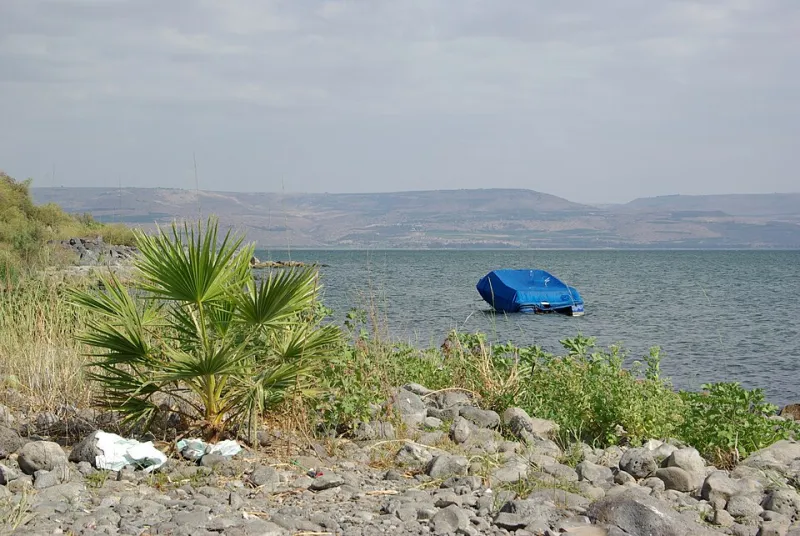
Photo: Berthold Werner, CC BY-SA 3.0, via Wikimedia Commons
The dock at Tiberias is already warm by seven, and the water beyond it has that flat, hammered look that photographs never quite catch. A pilgrim steps aboard a wooden-hulled boat, takes a bench on the starboard side, and watches the western shore — the domes, the hotels, the road running north toward Capernaum — begin to slide away in pieces.
Most passengers on such a crossing are after a quiet hour on the water and a return to the same dock before lunch. The Gospels have something else in mind.
A Lake You Can Cross Before Breakfast
Thirteen miles long and roughly eight wide, the Sea of Galilee is small enough that a determined boat can reach the far side in well under an hour. On a clear morning you can see the opposite hills from the pier. For the men who fished these waters, however, the eastern shore was never a scenic overlook. It was a boundary.
West of the water lay Jewish Galilee: synagogues, ritual baths, villages that ordered their weeks around the Sabbath and their kitchens around the Law. East lay the Decapolis, a league of Greek-speaking cities — Hippos on the bluff above the shoreline, Gadara a few miles inland — with temples, theaters, Roman coinage, and herds of swine. When Mark notes that a great herd of pigs was feeding on the hillside, he is not adding local color. He is telling the reader that Jesus has left the neighborhood.
A Command That Made No Sense
'Let us go across to the other side,' Jesus says in Mark 4:35, at the close of a long day of teaching from a boat. It sounds like a simple instruction until you know the map.
The disciples were fishermen from the western ports. They knew what waited on the far shore: tombs cut into the rock, a garrison town, altars to gods they did not worship. To cross was to step outside the boundaries that had organized their whole lives. And the errand was, by any practical measure, unnecessary. There were villages enough on the western side.
That, perhaps, is why the crossing is worth studying. It was not a journey anyone in the boat would have chosen.
The Storm Belongs to the Story
Before the boat reaches the far side, a squall comes down off the hills — the kind of sudden, violent weather that the lake still produces. The men who had spent their lives on this water are terrified, which tells you the storm was serious. They find Jesus asleep on a cushion in the stern and wake him with the question that runs beneath every pilgrimage: 'Teacher, do you not care that we are perishing?'
He rebukes the wind. The water goes flat. And then he asks them why they are so afraid, and the terror in the boat changes character entirely: 'Who then is this, that even the wind and the sea obey him?'
Notice the shape of the passage. The crossing opens with a question about whether Jesus cares, and it closes with a question about who he is. Between those two questions sits a Gentile shore.
Landing Where No One Wanted to Go
Mark gives the arrival in a single verse: 'And when he had come out of the boat, immediately there met him out of the tombs a man with an unclean spirit' (5:2). The details that follow are grim and specific — night and day among the tombs, crying out, bruising himself with stones, bound with chains that he tore apart. The town had tried the obvious solutions and had run out of them. So it had done what communities often do with people they cannot fix: it had left him among the dead.
The man runs to Jesus and names him — 'Son of the Most High God' — before giving his own name: Legion, 'for we are many.' A legion was a Roman military unit several thousand strong. The name is a confession of occupation, and the whole scene, with its tombs and swine and steep bank, reads like a country under someone else's flag.
The Price the Town Could See
When the herd rushes down the slope into the lake, the herdsmen run for town. The people come out and find the man 'sitting, clothed, and in his right mind.' And then they do the strangest thing in the story: they beg Jesus to leave.
They had not doubted his power. They had counted its cost — the swine, the disruption, the unsettling presence of a man who does not negotiate with the way things are — and they preferred the ledger they already knew.
It is easy to read this scene with contempt from a tour boat. It is harder to read it beside a calendar, a budget, and a comfortable Sunday routine.
The Man Who Was Told Not to Come Along
As Jesus steps back toward the water, the healed man begs to go with him. It is the instinct of anyone who has been rescued and wants to stay near the rescuer, and it is the request we would expect Jesus to honor.
He refuses it. 'Go home to your friends and tell them how much the Lord has done for you, and how he has had mercy on you' (5:19).
This is nearly the reverse of Jesus's usual instruction. Again and again in the Gospels he tells the healed to say nothing. Here the command is to speak, and the destination is home — a pagan home, in a pagan league, among people who had given up on him. The first evangelist to the Gentiles, in Mark's account, is a man with a troubled past and no training, sent back to the very neighbors who had chained him.
The Harder Half of the Journey
The boat goes back without him. That is the detail worth carrying home.
Leaving is the easy half of discipleship. The ticket, the packing, the departure prayer, the emotion of standing on a shoreline you have read about since childhood — all of it comes naturally. The return trip is where the work begins, because the return trip is where nothing is novel anymore. The men who crossed back to Capernaum came home to the same nets and the same shoreline, but not to the same world. They had seen a man restored and a town refuse the restoration, and they could not unsee either.
For the Gerasene man the return was literal: he went home. For the disciples it was a homecoming with an assignment attached. Both were sent.
Pilgrims tend to plan carefully for the outbound leg and hardly at all for the flight home. Yet the harder questions arrive at the airport, in the church parking lot, at the kitchen table where someone asks how the trip was. What did you see that you cannot now ignore? Whom were you sent back to?
Standing on the Eastern Shore
If you make the crossing, ask your boatman to bring you near Kursi, where the traditional site of the encounter is marked by a slope that still falls steeply to the water. Stand for a few minutes with the western hills behind you and consider how strange it felt for the disciples to have that view at their backs.
Read Mark 4:35 through 5:20 aloud on the water, before the engine turns for home. Then keep silence on the return leg. Few things prepare a pilgrim for reentry better than an hour of quiet with that story still in the air.
A Question to Carry Back
The country of the Gerasenes is not a warning about dangerous places. It is a portrait of what happens when Christ steps outside our arrangements — and of a man who was sent home to describe it. The question the far shore leaves with us is not only whether we will get into the boat. It is whether we will go home different, and say so.